Ainkawa mayor about the Assyrians in Ainkawa, a Christian Assyrian town with 20.000 inhabitants in Hewler, southern Kurdistan.
Ainkawa in Kurdistan is a role model for the rest of Iraq says the mayor and president of the KRG (Kurdistan Regional Government) Massoud Barzani.
"Assyrians and Kurds together without no problems"
"KRG cares about Ainkawa and Barzani respects Christians"
Kurdish government about Assyrian-Kurdish brotherhood
Monday, September 29, 2008


Saturday, September 27, 2008
Thursday, September 25, 2008
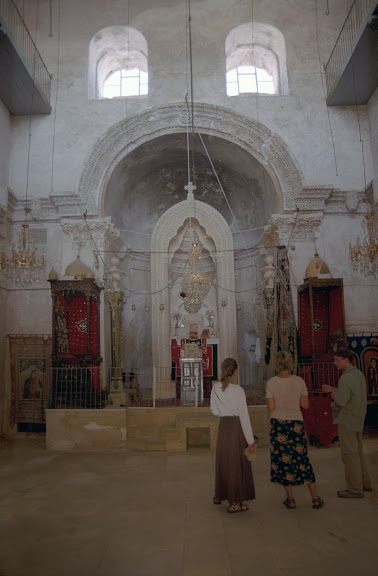
Churches in Ainkawa

Saint Elias Church in Ainkawa

St. George church in Ainkawa

St. Joeseph church in Ainkawa


Tuesday, September 9, 2008
Iraq gets its first Christian militia - with a little help from the peshmerga

Daily star
Karim Talbi
Agence France Presse
TEL ASQUF, Iraq: With Kalashnikovs slung over their shoulders, members of Iraq's first Christian militia enforce one simple rule on the border of this little village: "Anyone not from Tel Asquf is banned." This village in northern Iraq's flashpoint Nineveh Province, frequently targeted by Sunni and Shiite fighters, has now taken security into its own hands with armed patrols and checkpoints at the village's four entrances.
The village borders are marked with a sand barrier built by residents in a bid to stop car bombs breaching the perimeter as they did in 2007 when two such attacks within six months rocked the village and spurred the local authorities into action.
"The terrorists want to kill us because we are Christian. If we don't defend ourselves, who will?" asked militia group leader Abu Nataq.
Associated with the "Crusader" invaders and regarded as well-off, Iraqi Christians are often victims of sectarian violence, killings and kidnappings at the hands of both Sunni and Shiite Islamists, as well as criminal gangs.
Iraq's Christians, with the Chaldean rite by far the largest community, were said to number as many as 800,000 before the 2003 US-led invasion, but this number is believed to have halved as people fled the brutal sectarian violence.
Neighborhood militias have become popular in Iraq, particularly with the rise of the Awakening groups - former Sunni insurgents who switched sides after being paid by US forces to battle Al-Qaeda.
But Iraq's Christian population, concentrated in Nineveh and its capital city Mosul, had not until now organized its own fighting force.
"We used to pay 'jezya' [protection money] and they would leave us alone," Nataq said in reference to a tax levied on the Christian community by Al-Qaeda in exchange for peace.
The term harks back to the seventh century, a period of great expansion in Islam when Christians and Jews were forced to pay additional taxes to the majority Muslims.
But Tel Asquf's villagers rebelled against the payments and called on the help of the Kurdish forces of Irbil, the nearby capital of Iraq's Kurdish region, after judging that its own provincial capital, Mosul, had too large a Sunni Arab population.
"I prefer the help of Kurdistan, of the peshmerga," Nataq said. The Kurdish fighters now controlled the roads leading to the village and claimed large swathes of the region, much to the fury of Mosul's Arab population, he added.
The peshmerga provide Kalashnikov rifles and radios to the 200 Christian militiamen who receive around $200 dollars a month from the Irbil administration to protect the 8,000 inhabitants of the village.
| |
Since the arrangement was introduced around 10 months ago, the Christian militiamen have never had to use their weapons, "because the peshmerga form the first line of defense," Nataq said.
Christian fighters are stationed at the village's entry points and mobile teams patrol inside the inner cordon, especially around the Chaldean Catholic Church of St. George, which, like many of Iraq's churches, has paid a heavy price in this blood-soaked land.
On January 6, a series of bombs at outside churches and a monastery in Mosul, in an apparently coordinated attack that wounded four people and damaged buildings, as Christians celebrated Epiphany. In March, the body of Iraq's kidnapped Chaldean archbishop, Paulos Faraj Rahho, was found near Mosul, prompting the condemnation of Pope Benedict XVI and US President George W. Bush.
Along with thousands of other Christians, the archbishop used to pay the jezya but decided to stop. Some believe that this was the reason for his kidnapping and murder.
Hani Petrus, 45, fled to Tel Asquf seeking refuge from the bloodshed, like dozens of other Christians from Baghdad, Samarra and Basra.
"I am a school headmaster but I used to work in a petrol station in Mosul. The terrorists used to come and serve themselves petrol for free and take money from the cash register: $200 to $300 each time," he said.
"In Mosul, my children were not able to play in the street. I didn't want to let my 12-year-old daughter go to school. I was so worried about her," he said, adding that his family was one of four families into one house.
"We are virtually living on top of one another and everything is expensive because the shopkeepers know that we cannot make the trip into Mosul," he said.
Salem Samoon Jbo, 46, used to sell liquor in Basra but fled north, first to Baghdad and then Tel Asquf, after Shiite extremists ordered him to close the store in 2006. They had learned that he was working for the US forces. Now he stands guard outside one of the entrances to the St. George Church. He works seven days - alternating two hours on duty and two hours off - then takes two weeks off.
"There isn't any other work here. There is nothing else to do. I don't like guns but I have no other choice," he said. "In any case, it is better than the work in Basra. There, I worked for the Americans and was a target for the Shiite militias. I worked as a bomb-disposal expert."
Monday, September 8, 2008

Thursday, August 7, 2008
The Kurdish Holy Bible

In 1857, the Bible was translated into Kurdish for the first time. It was translated from Greek into Kurdish Kirmanji and printed in the Armenian alphabet in Istanbul by Armenian missionaries and saints.
The second edition of the second translated book titled Alpha Be Jeya Kirmaniji and Armenian is in the Kirmanji dialect, in the Armenian alphabet, and again was published and printed in Istanbul with the assistance of Armenian authors and saints. The book is in both Kurdish and Armenian.
The Holy Bible in Kurdish : Kitêba Pîroz.
The Bible is holy and nothing other than holy.
Amîn!
We love because he first loved us. If anyone says, "I love God," yet hates his brother, he is a liar. For anyone who does not love his brother, whom he has seen, cannot love God, whom he has not seen. – 1 John 4:19-20
Do not be a liar! Love your fellow Kurdish brother and sister.
Moslem, Christian, Jew, Yezidi...
We are KURDS from Kurdistan
Kurdistan where the apostles and Bible figures in the past have walked.
May HE bless all
day walked
We love because he first loved us. If anyone says, "I love God," yet hates his brother, he is a liar. For anyone who does not love his brother, whom he has seen, cannot love God, whom he has not seen. – 1 John 4:19-20
Do not be a liar! Love your fellow Kurdish brother and sister.
Moslem, Christian, Jew, Yezidi...
We are KURDS from Kurdistan
Kurdistan where the apostles and Bible figures in the past have walked.
May HE bless all
day walked

Sunday, August 3, 2008
What Jesus said of himself
 Jesus said unto him, I am the way the truth and the life. no man commeth to the Father but by me. John 14:6
 Jesus said unto him... he that hath seen me hath seen the Father. John 14:9
Therefore whosoever heareth these sayings of mine and doeth them, I will liken him unto a wise man, which built his house upon a rock: And the rain descended, and the floods came, and the winds blew, and beat upon that house; and it fell not: for it was founded upon a rock. Matthew 7:24,25
God save Kurdistan
Turkey's unsafe Christians
A group of young Turkish men are on trial accused of the murders of three Christian missionaries.
In certain areas of the country there is distrust and and anger between Muslim and Christian communities.
In certain areas of the country there is distrust and and anger between Muslim and Christian communities.
Greek Kurdish Song
This song is written and performed by Kurdish singer, Diyar and Greek singer, Sofia Papazoglou...
"Elefteria was a Greek woman that set herself aflame to make the international community aware of the drama of the Kurdish people. The fact that we Greeks have always sympathized and identified with the the Kurds was never a mystery to me, but by getting closer to the 'Kurdish soul' through this opportunity, I realized the bond between the two peoples (Greek and Kurd) is a much deeper and more complicated affinity, with its roots not only deep into the past, but also into a future that needs to be realized." - Sofia Papazoglou

Long Live Greece. Long Live Kurdistan.
Love Live Peace, Brotherhood and Unity for the Kurdish and Greek people and for the world!
Sunday, July 27, 2008
Assyrians in Kurdistan

Assyrian children playing in the cemetery of Ankawa near Arbil where more than 3,500 Christian families have fled to from Baghdad, based to Kurdish statistics. According to sources to Zinda in Arbil, a $3 million building project is underway for the Patriarchate of the Assyrian Church of the East in the same area, a gift of the Kurdish Regional Government to His Holiness Mar Dinkha IV. (AFP/Safin Hamed)



Subscribe to:
Posts (Atom)